

Pasadena, CA-(ENEWSPF)- NASA’s senior Mars rover, Opportunity, is departing “Cape Tribulation,” a crater-rim segment it has explored since late 2014, southbound for its next destination, “Perseverance Valley.” The rover team plans observations in the valley to determine what type of fluid activity carved it billions of years ago: water, wind,[Read More…]
Space
Solar Storms Can Drain Electrical Charge Above Earth
A solar eruption on Sept. 26, 2014, seen by NASA’s Solar Dynamics Observatory. If erupted solar material reaches Earth, it can deplete the electrons in the upper atmosphere in some locations while adding electrons in others, disrupting communications either way. Credits: NASA CALIFORNIA–(ENEWSPF)–April 11, 2017. New research on solar storms[Read More…]

NASA’s Cassini Mission Prepares for ‘Grand Finale’ at Saturn
Washington, D.C.-(ENEWSPF)- NASA’s Cassini spacecraft, in orbit around Saturn since 2004, is about to begin the final chapter of its remarkable story. On Wednesday, April 26, the spacecraft will make the first in a series of dives through the 1,500-mile-wide (2,400-kilometer) gap between Saturn and its rings as part of[Read More…]

STScI: Hubble Witnesses Massive Comet-Like Object Pollute Atmosphere of a White Dwarf
Baltimore, MD-(ENEWSPF)- Scientists using NASA’s Hubble Space Telescope have witnessed a massive object with the makeup of a comet being ripped apart and scattered in the atmosphere of a white dwarf, the burned-out remains of a compact star. The object has a chemical composition similar to Halley’s Comet, but it is[Read More…]

Mars Volcano Arsia Mons, Earth’s Dinosaurs Went Extinct About the Same Time
By Elizabeth Zubritsky NASA’s Goddard Space Flight Center in Greenbelt, Maryland Greenbelt, MD-(ENEWSPF)- New NASA research reveals that the giant Martian shield volcano Arsia Mons produced one new lava flow at its summit every 1 to 3 million years during the final peak of activity. The last volcanic activity there[Read More…]
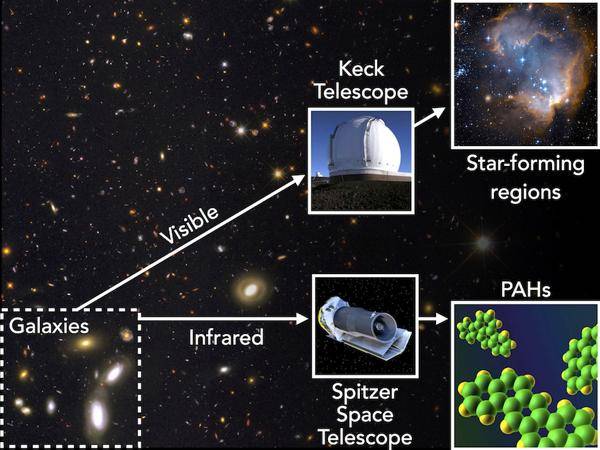
Tracing Aromatic Molecules in the Early Universe
By Sean Nealon RIVERSIDE, Calif. (www.ucr.edu) — A molecule found in car engine exhaust fumes that is thought to have contributed to the origin of life on Earth has made astronomers heavily underestimate the amount of stars that were forming in the early Universe, a University of California, Riverside-led study[Read More…]

Gigantic Jupiter-type Planet Reveals Insights Into How Planets Evolve
UCLA, Carnegie Institution astrophysicists get rare peek at a baby solar system 300 light-years away Los Angeles, CA-(ENEWSPF)- An enormous young planet approximately 300 light-years from Earth has given astrophysicists a rare glimpse into planetary evolution. The planet, known as HD 106906b, was discovered in 2014 by a team of[Read More…]

Hubble Discovery of Runaway Star Yields Clues to Breakup of Multiple-Star System
Baltimore, MD-(ENEWSPF)- As British royal families fought the War of the Roses in the 1400s for control of England’s throne, a grouping of stars was waging its own contentious skirmish — a star wars far away in the Orion Nebula. The stars were battling each other in a gravitational tussle,[Read More…]

Scientists Identify A Black Hole Choking On Stardust
Jennifer Chu, MIT News Office Data suggest black holes swallow stellar debris in bursts. Cambridge, MA-(ENEWSPF)- In the center of a distant galaxy, almost 300 million light years from Earth, scientists have discovered a supermassive black hole that is “choking” on a sudden influx of stellar debris. In a paper[Read More…]
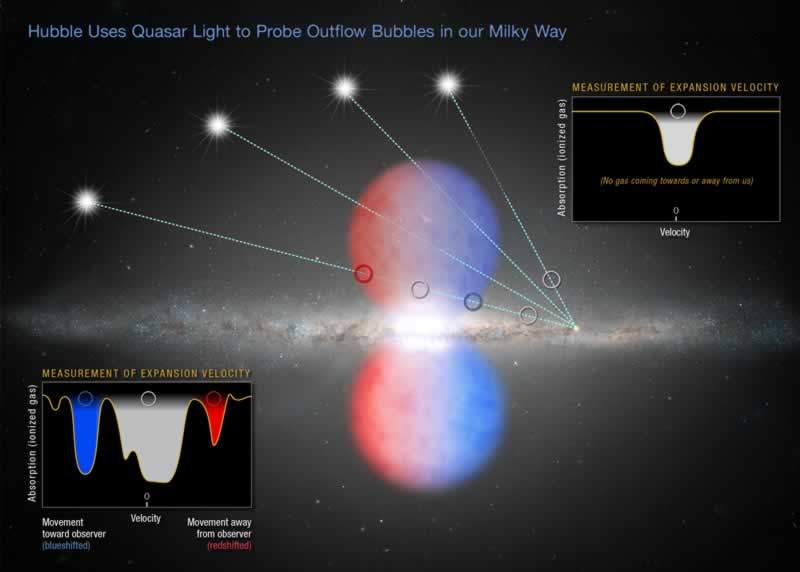
STScI: Hubble Dates Black Hole’s Last Big Meal
Baltimore, MD-(ENEWSPF)- For the supermassive black hole at the center of our Milky Way galaxy, it’s been a long time between dinners. NASA’s Hubble Space Telescope has found that the black hole ate its last big meal about 6 million years ago, when it consumed a large clump of infalling gas.[Read More…]


