


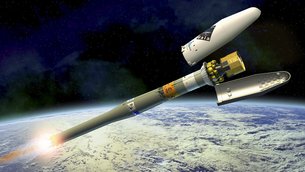
Gaia launch
EU–(ENEWSPF)–17 December 2013. Shortly after a powerful Soyuz launcher lofts Gaia, ESA’s new star mapper, into space on Thursday, teams on the ground will establish initial radio contact. Even then, tension will run high in ESA’s mission control as Gaia must still perform a critical automatic sequence.

An astrometry mission, Gaia will observe a thousand million stars on average 70 times over a five-year period.
It will precisely chart their positions, distances and movements, and is expected to discover thousands of new celestial objects, such as extrasolar planetary systems and brown dwarfs. It will also observe hundreds of thousands of asteroids within our own Solar System.
The first step in its journey is set to happen on 19 December, when it will be launched towards the Sun–Earth L2 orbital position on a Soyuz rocket from ESA’s Spaceport in Kourou, French Guiana.


