


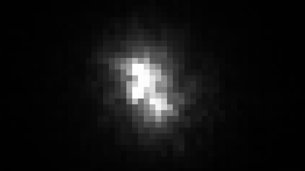
Focal spot: laser light seen by infrared camera
EU–(ENEWSPF)–1 November 2013. ESA’s ground station on the island of Tenerife has received laser signals over a distance of 400 000 km from NASA’s latest Moon orbiter. The data were delivered many times faster than possible with traditional radio waves, marking a significant breakthrough in space communications.

The Lunar Atmosphere and Dust Environment Explorer, or LADEE, was launched on 7 September and arrived in orbit around the Moon in October. In addition to probing the Moon’s environment, it’s also carrying a new laser terminal.
This new approach promises data speeds far superior to traditional radio waves used today by satellites and ground stations, including the Agency’s Estrack network.
ESA’s Optical Ground Station in Spain’s Canary Islands was upgraded with an advanced laser terminal developed in Switzerland and Denmark that can communicate with LADEE using highly focused beams.


